Showing posts with label art history. Show all posts

10.31.2016

Judith

10.31.2016
It's here, my favorite day of the year!!! This October felt very important. I feel like I stepped into something significant this month. October is always so special to me. The veil between worlds is thinnest now and I really can feel it. One of the artists I featured last post wrote an amazing description of the history of Halloween so definitely check it out here: (x). Even though the month is almost up, I feel that I have begun to uncover more of myself and I don't want to give that path up. As we enter the "dark half" of the year, you can expect more witchiness, magic, femininity, and nature. This time of the year is always so cleansing to me, I just love it. 

I worked SO HARD on my costume this year, and I am so pumped to share it. I decided to embody Gustav Klimt's "Judith with the Head of Holofernes" from 1901. This work depicts the Old Testament heroine Judith, who used her sensuality to lure her enemy Holofernes (the general who was trying to take over her village) to her. After she had gotten the man drunk, she cut off his head, thus saving her village. She is looked at as a symbol of piety and modesty. Even though she used her sensuality to lure a man, she did it for her religion and people. In the Renaissance, this idea was explored through many paintings under a theme called "Power of Women". This topos explored the ways in which women could dominate men. It seems that Klimt tapped into this idea, making his Judith more of a femme fatale character. When he first painted this, his mostly Jewish elite audience was shocked, thinking that perhaps he meant to title the piece after Salome, a more sinister character. But no, his woman was Judith and she became the symbol a woman who is both sexual and respected. I love her unapologetic vibes and I was so excited to make this costume.

read more "Judith"

10.29.2016

Inspiration: The Season of the Witch

10.29.2016
Prehistoric and Classical Art 
I feel I need to begin my discussion by mentioning that women were once worshiped for their magical abilities. This Minoan Snake Goddess was praised for her closeness to nature through snakes, since snakes slithered on the earth. Snakes also shed their skin, so they are symbols of transformation which became a major theme in witchcraft and magic throughout the world in general. Hekate in Greek mythology was a well-respected and worshiped goddess of witchcraft and magic. She was also thought to be a protector of children, even though witches were later thought to be harmful towards children. Know your roots, kids! The witch was sacred before man tainted her.
Medieval and Renaissance Art
Now we jump to my favorite period. A time when women were thought to be witches simply because they were women. They were burned, drowned, and hung simply for understanding things that men did not. Art from the time reflected men's fears, depicting witches simply as naked women. Their nudity was thought to be a symbol of temptation. A witch could tempt a man into wickedness, and therefore men made their art a warning against them. I wrote a whole article on this in Lone Wolf Magazine (x) if you are interested! 
Francisco Goya
Goya used his witch paintings as a criticism of the tactics used during the Spanish Inquisition. He used them to make fun of the superstitions held by the government that he saw as medieval and wrong. His paintings feature traditional witch imagery: the women are nude and sometimes levitating. Goats represent the devil, proving how ridiculous the fear of the devil is. Goya's witches aren't used to comment on the female sex, but rather the social environment that the artist lived in. 
Pre-Raphaelite Movement
With the Pre-Raphelite movement, artists sought to regain what was "lost" with the Masters of the Renaissance. They thought that the strict formulas and poses for art-making were too restrictive, so they wanted to return to the bright colors and attention to detail of the Italian Quattrocento. Their subjects were often women and the beautiful subjects of literature. They were concerned with nature and oftentimes magic. For this reason, the witch imagery that came from this era marked a switch in the witch identity. No longer were they necessarily evil women to be feared. Instead, they were women close to nature, their beauty and symbolism emphasized. Characters like Morgan Le Fay  and Circe were popular to paint, since they represented themes of magic, transformation, and prophecy. Basically, magical women were actually revered during this period of art.
Marjorie Cameron
I have a lot of feelings about this woman, so I will try to keep it short. Marjorie Cameron was an Los Angeles-based artist, mostly prominent during the 50s and 60s. She worked with her husband, Jack Parsons, who was a scientist in Pasadena. Together they worked to unlock secrets of the occult. Her art reflected her explorations, as she often drew amazing witchy women and surreal characters. 
The Amazing Witchy Artists Today!!!
I follow a lot of witch artists on Instagram and I just had to share a few with you. I love the amazing surge of magic happening within women right now. I mean, it's always been there, but it's just exciting to live in a world where we can share our art and magic so easily. Some favorites are Poison Apple Print Shop (x), Mori Raito (x),  and Rebecca Artemisia (x). 
This blog (and my life) has no shortage of witch musings. Naturally I have to get extra witchy this time of year, so I wanted to do a post on my favorite subject: witch art! The image of the witch has changed quite a bit throughout time and I find this evolution to be fascinating and indicative of attitudes toward women, sexuality, and nature. I hope this has inspired you just a lil' bit. I could honestly spend my whole life studying the evolution of witches in art (and I just might). Just remember that the "witch" wasn't always the green-skinned lady in The Wizard of Oz. Witches have a colorful history, and their stature as terrifying women alone is enough to make them feminist icons. 
read more "Inspiration: The Season of the Witch"

9.30.2016

Inspiration: Ziegfeld Follies

9.30.2016
A post for the last day of September that really just signifies me looking forward to October. Things are about to get real spooky on my blog. I just love Halloween and I can't help but make the entire month about it. For now I want to share some amazing costumes with you to kick off the best season of the year. I recall finding a book on the Ziegfeld Follies during my freshman year of college and falling absolutely in love. The Ziegfeld Follies was a revue show in New York in the 1920s. It was something like a Broadway show but also a vaudeville variety show. Most importantly, the "Ziegfeld Girls," who I imagine were like the 20s equivalent of go-go dancers, were dressed in the most exquisite costumes EVER. Here are some photographs of the costume collection entitled "The Illuminants."
"The Illuminants" is a costume collection based on different sources of light. The girls are dressed as the moon, a lightbulb, a lantern--and the one on the left just above is the Northern Lights which I find to be fantastic. Something about this collection in particular embodies the wonder of the 20s for me. It reflects a time when technology was changing but old superstitions still remained. The same could be said for today, I suppose, but I just like to think about how sparkly the world would have looked at this time when universal electricity was new and exciting. I've always felt like I responded very strongly to different light sources and as a photographer light is very important to me, so I just love this.

I'm not positive who designed these costumes, but I  would assume it was Erté, who designed a lot of the show's pieces. Erté was a sort of "King of Art Deco" and was a contributor to Harper's Bazaar as a fashion illustrator, as well as to show business with design. Erté just makes me dream.
read more "Inspiration: Ziegfeld Follies"

9.22.2016

Muses: Julia Margaret Cameron

9.22.2016
The fantastic thing--though also possibly overwhelming--about being an artist today is the accessibility we have to so much inspiration. The internet, along with dedication of those who work to preserve our culture's consciousness in museums, archives, and beyond, has given us a chance to engage with the artists that came before us in a beautiful way. The fact that I can simply type "Julia Margaret Cameron" into my search bar and come up with a beautiful array of images makes me so thankful for the age in which we live. I can compile a blog post like this and say, "Look look at this!" and then carry that inspiration with me.

This ease of accessibility is certainly a blessing, but often I get nostalgic for a time when art had a little more mystery. Before social media, self-promotion happened with a little more effort. Pursuing a new art form didn't come from dabbling, but rather from an "all-in" mentality. For instance, my girl Julia Margaret Cameron here put her life into marketing, showing, and copyrighting her work. Within 18 months of the start of her career, she had sold 80 prints to the V&A(x). Her dedication to her craft is something that has been sitting with me, and for that reason she is my muse this week. 

Julia Margaret Cameron began her career in photography at the age of 48. That's right! This badass lady didn't become famous at a young age, wasn't an It-Girl (well she did run in a circle of elites like Tennyson and Charles Darwin). Instead, she made her name simply by doing the damn work. She figured out her own style and perspective by experimentation. In the face of much doubt, she strived to make her photography akin to the artists of the Italian Renaissance. While photographers of the time were concerned with technical skills, Cameron preferred to imbue her work with a certain spirit rather than perfection. Other photographers accused her photos of being out of focus with incorrect shadows or coloring. While she wished to bring mythology and history to life, other men in her field found her work to be worthy of mockery and derision. I can't help but wonder, dear readers, if perhaps her subject matter and style were seen by male photographers as trivial and unstudied only because she was a woman. Ah, the age-old question. Still, I cannot travel in time to convince their sorry (and uncelebrated) asses of her brilliance. I can only admire her here. 

A bit about her subject matter: she brought in only her friends to sit for her. She didn't do commissioned portraits, but preferred to stage her portraits in order to evoke a character or feeling specific to her work. Her subjects complained about the amount of time they had to hold their poses, often in romantic and dramatic outfits. She brought to life Arthurian legends and mythic archetypes. I love work like hers because it proves the eternal fascination that mankind has with stories. There are some things that never die, and it seems that the stories she has tapped into are some of them. And what better way to make them true than by photography? 


Julia Margaret Cameron is an inspiration to me both because of her dreamy subject matter and her devotion to the craft. She is proof of the fact that one really can start a new art (or career path/hobby/life/personality/whateverrr) at any age. She rarely took no for an answer. She inspires me to be fearless in the things I love, and to listen to the things I am drawn to. 
read more "Muses: Julia Margaret Cameron"

6.14.2016

I GRADUATED!!!!

6.14.2016
GUYS I DID IT! Well technically I have one more paper to write but the sentiment remains. I finished UCLA! For y'all who don't know, my college experience has been a complicated one. I started at UC Santa Cruz, which I loved a lot but it wasn't the right place for me. I took some time off, met my love at a study abroad trip in London, then went back to school at Chapman University. That really wasn't the right place for me either, so I left that too. Finally I found a home at UCLA and finished my undergrad work in a year. I took a lot of classes (like a lot) and really stressed myself out like crazy. But I'm so glad I did it and I'm so proud of everything I've done. Now you will never have to listen to me complain about school again! (Until grad school, whoops hahahah).

I got A's in every single one of my classes. I wrote an Honors Thesis of 35 pages on Hieronymus Bosch, an artist I have loved since I was 18 and first found Art History. I joined an on-campus magazine and had so much fun taking photos and writing stories. I was one of two people in my major to present at Undergraduate Research Week. I successfully figured out the Los Angeles bus system!!! Even if I don't continue on in my Art History education (although I am pretty sure I will) I feel so proud and so comfortable with the skills in writing and critical thinking that I have acquired from my major. I feel that I understand the world and its visual culture so much more than I could have as just a Studio Art major or even as an Art History major at another school. UCLA was so good to me.

Of course now I'm left with "What do I do now?" I think I will buy myself a new camera (possibly tonight; I want it baaaad) because mine can't even focus let alone take a high-quality image. I'm excited to have a camera capable of the kind of work I want to do. All I really plan to do this summer is work a little bit, take photos, write, make some stuff, and adventure. I'm so ready for a break. 

 Of course, I would not be where I am without the amazing people in the HILARIOUS photo below and everyone I have met on my journey. I have the most wonderful friends and family who support me in my weird and complicated ways of doing things. Oh also one more thank you is to my friend Alyssa who managed to snag me the last dress of my size in this style by Keepsake from Revolve. I need to take real pictures of it soon. It made my Beyonce Lemonade dreams come true and it deserves some pretty pics.

 Just one more note: unfortunately the last few weeks of school were touched by some sadness. During one of my finals, the entire school went into lockdown because of a shooting on campus. An engineering professor was killed by a former student. The UCLA community is very strong and we have dealt with the tragedy together but it is a very scary and awful thing. On Saturday night the unthinkably horrific shooting in Orlando happened. It's been an incredibly scary few weeks. I live two blocks from where LA Pride was held and I was so scared I would get news of hate crimes there. To think of any of the people who were in a space they thought was safe for them only to be met by events I can't even think of without feeling sick is so...I mean it's beyond words. I know I have a lot of followers that don't live in the US and I'm not sure what me saying anything on here will do, but we just need to make a change. It is absurd that people can purchase the weapons they can and it is absurd that these things keep happening. I feel sad that these events happened at a very happy time in my life, and quite guilty that I can continue to celebrate with my friends and family while so many are suffering. But I guess all we can do is start conversation and put out positive vibes to enact some change while remembering those who lost their lives and sending good thoughts to their family. We need to love each other. 


read more "I GRADUATED!!!!"

4.22.2016

Inspiration: Bosch by Tim Walker

4.22.2016
I'm currently working on my Honors Thesis at UCLA. It feels very intimidating not only because it's a 30 page research paper that I have to get an A on to pass, but also because I care deeply about the subject. I'm writing about women in the art of Hieronymus Bosch.  I found Bosch my freshman year of college in my first ever Art History class. I fell in love with the colors and the weird magic and the frightening worlds he created 500 years ago. Not much is known about Bosch and that is what makes him so fascinating to study. You can come up with all kinds of theories about him and no one can really tell you that you are wrong. 


For Love Magazine's S/S 2016 issue, Tim Walker (the photographic love of my life) interpreted the work of Hieronymus Bosch (the Northern Renaissance love of my life). It was a dream come true...I almost couldn't believe my eyes when I first saw it. Tim Walker perfected captured the eerie feeling you get when you look at Bosch. With Valentino gowns and costumes by Shona Heath, this marvelous series was born. My only sadness is that I couldn't be there to witness it.
read more "Inspiration: Bosch by Tim Walker"

12.19.2015

Inspiration: Horst P. Horst

12.19.2015
On the hunt for photography inspiration, I came upon the work of Horst P. Horst. I'd seen his images before, and if you open up any issue of Vogue you can see his legacy clearly influencing the artists of today. I was particularly drawn to his lingerie photographs, as well as the beautiful photo of Salvador Dali's costumes for Leonid Massine's ballet Bacchanale. I think another post will have to be made for those costumes--I love when artists design costumes or props and backdrops for the stage. It's like stepping into their worlds. But anyways, the work of Horst P. Horst stands out to me because it is both elegant and strange. I like the way he obscures and shadows his subjects. He presents fashion as surreal and exciting. Very very cool.

read more "Inspiration: Horst P. Horst"

12.03.2015

Rain Room

12.03.2015
Ian and I got to go see Rain Room at LACMA! Ian remarked to me that LACMA does a really good job of combining really well-curated "serious" exhibitions and some fun projects that are just really cool. This is definitely one of those projects that feels very special but is also kind of like a playground. The group we went in with was a diverse mix of kids, old people, LA girls lookin' to Instagram it up, and serious art types. What's so cool about these immersive projects is that they kind of put everyone on the same field. Rain Room is part of the Light and Space movement that came out of Southern California. While the movement comes with quite a bit of theory and history, the actual pieces it produces are only brought to life when experienced. Meaning: they are only successful when they attract groups of people who are willing to forego thought and actually experience the sensations that Light and Space artists strive for. Rain Room turns you into a ball of joy and wonder as you cautiously but excitedly step forward into the rain. You spend the whole time hoping no water falls on you but secretly enjoying when it does. You can barely hear anything but the sound of falling water and the bright light is blinding but adds to the mystery. I just love it. 


read more "Rain Room"

4.14.2015

Salvation Mountain

4.14.2015
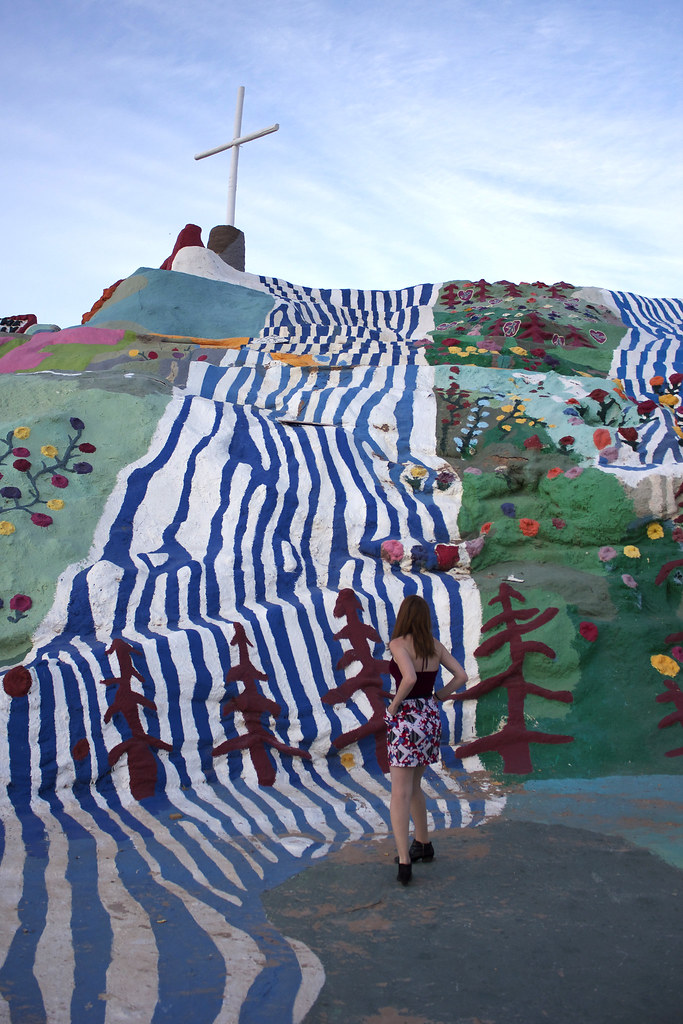
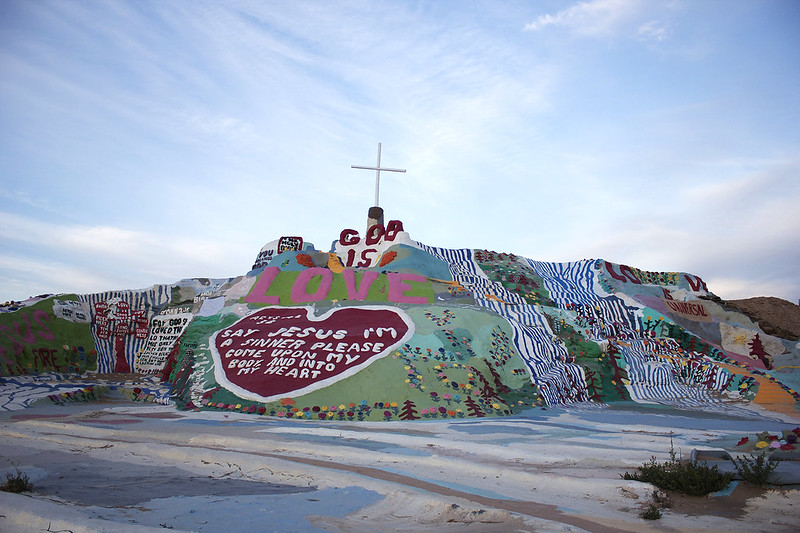
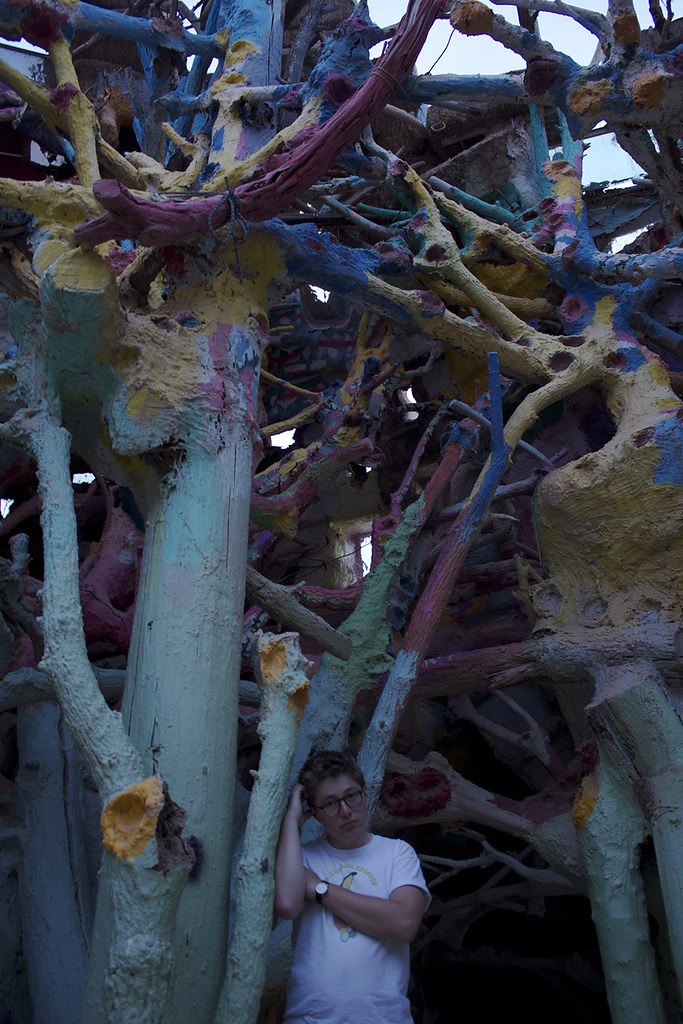
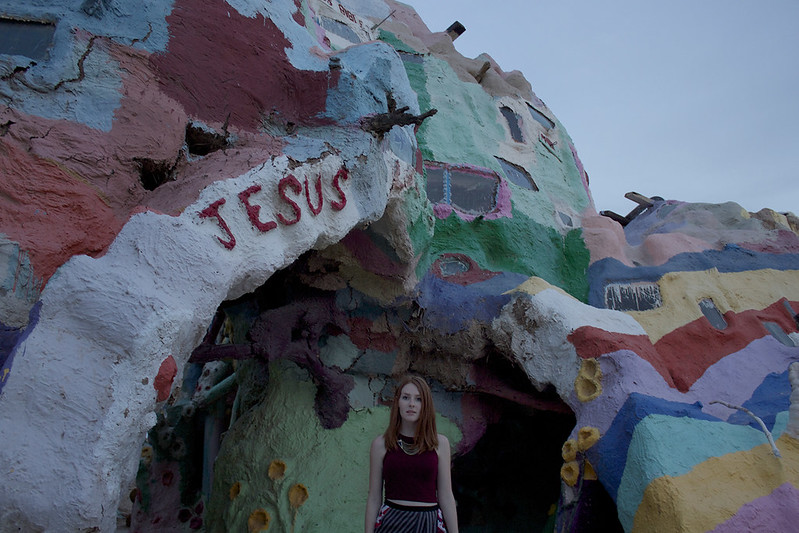
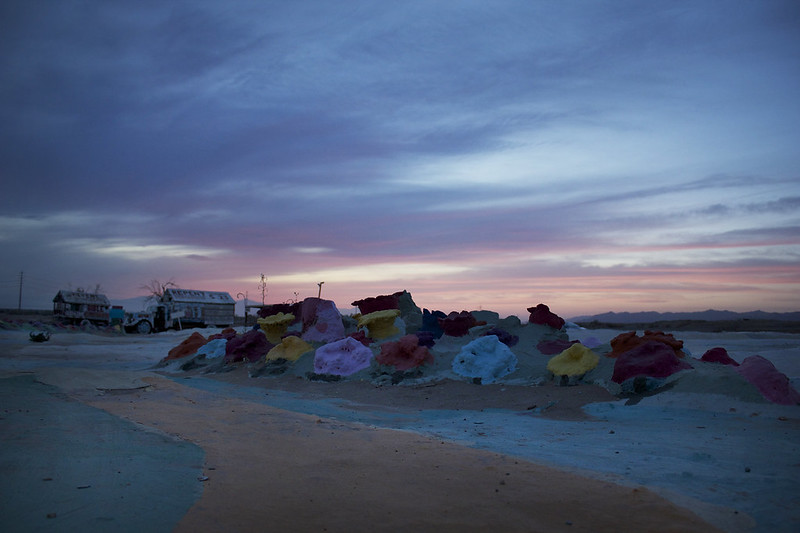
After Joshua Tree, we drove along the Salton Sea to Niland, California to see Salvation Mountain. I had been wanting to come here for a long time but it always seemed so far away. And, well, it was. It took us about two hours to get here from Joshua Tree and by the time we got there we were only 50 miles from the border to Mexico. We even had to go through border patrol. Salvation Mountain is in a place called Slab City. There is a very small town and people living in trailers and that's it. Then there is this painted-mountain weirdness a few miles out.

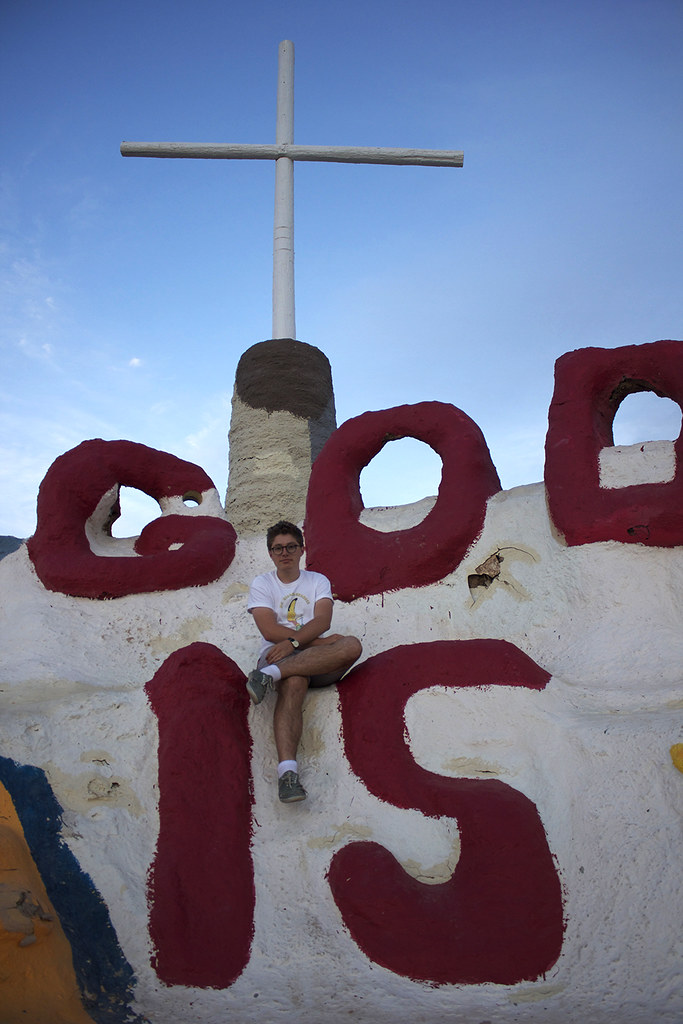
Salvation Mountain was made by a man named Leonard Knight. The project began in 1986 as a declaration of Knight's love for Jesus. He hoped that whoever came to the mountain would be inspired to accept God into their hearts. The monument is made of the mountain itself and a few little rooms called the Hogan and Museum. My favorite was the Museum, a dome supported by brightly-painted trees.

Untitled
Untitled
Untitled
Untitled

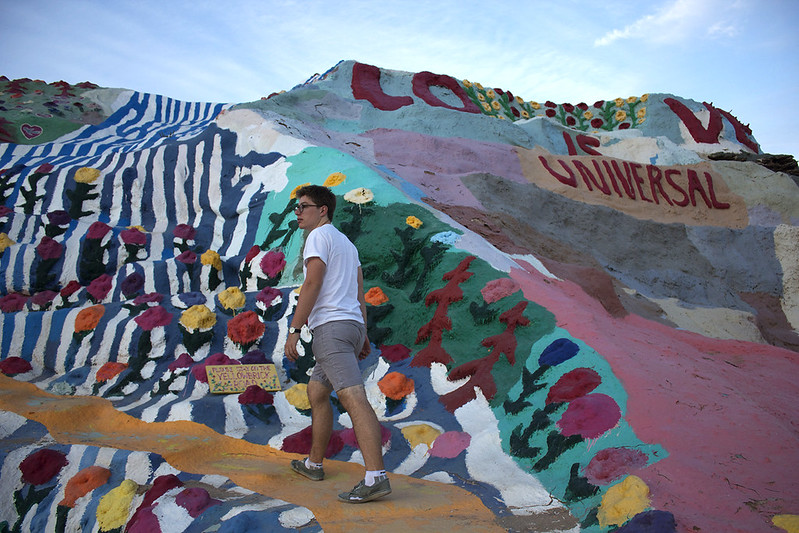
While I'm not Christian, or particularly religious, this mountain felt like it meant something. All the work that Knight put into the monument made me feel his message, and, if anything, appreciate his dedication to his beliefs. It's a place about love. It feels very surreal and otherworldly, which is how I think I could describe most of the desert, honestly. But that mystery added to Knight's huge and powerful message.

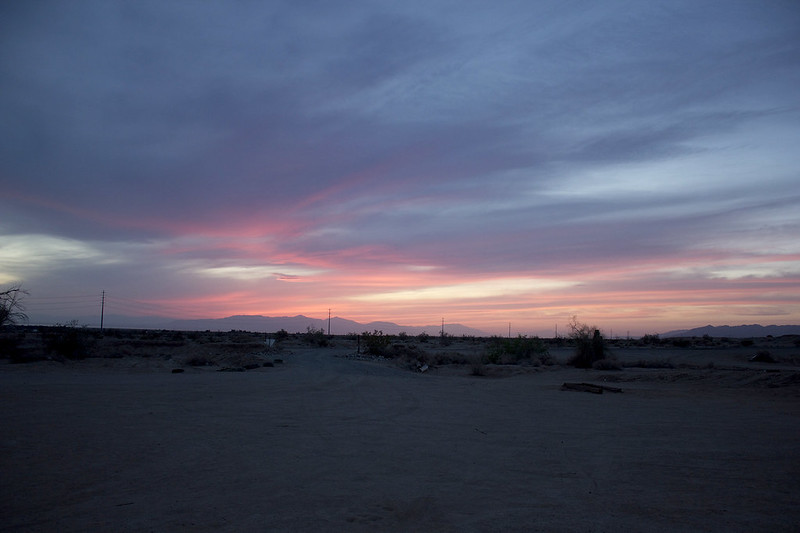
So Ian and I climbed around the mountain and explored the little rooms. We got there just as the sun was going down, which made it all the more eerie. As we left, though, the sky created a gorgeous sunset that we literally rode off into, leaving the mountain behind. It was a beautiful place and I hope to go back someday.

Untitled
Untitled
Untitled
Untitled
Untitled
Untitled
Untitled
read more "Salvation Mountain"